Dr. Elias Kairos Chen

AI Researcher · Entrepreneur · Strategic Adviser · Author

Framing the future of intelligence.

Exploring how artificial intelligence, agency and superintelligence are reshaping organisations, economies, governance and the human future.

I study intelligence, natural and artificial, and advise the leaders deciding what to do about it. My work runs from brain-inspired AI research to enterprise transformation, intelligent agency and the broader implications of superintelligence.

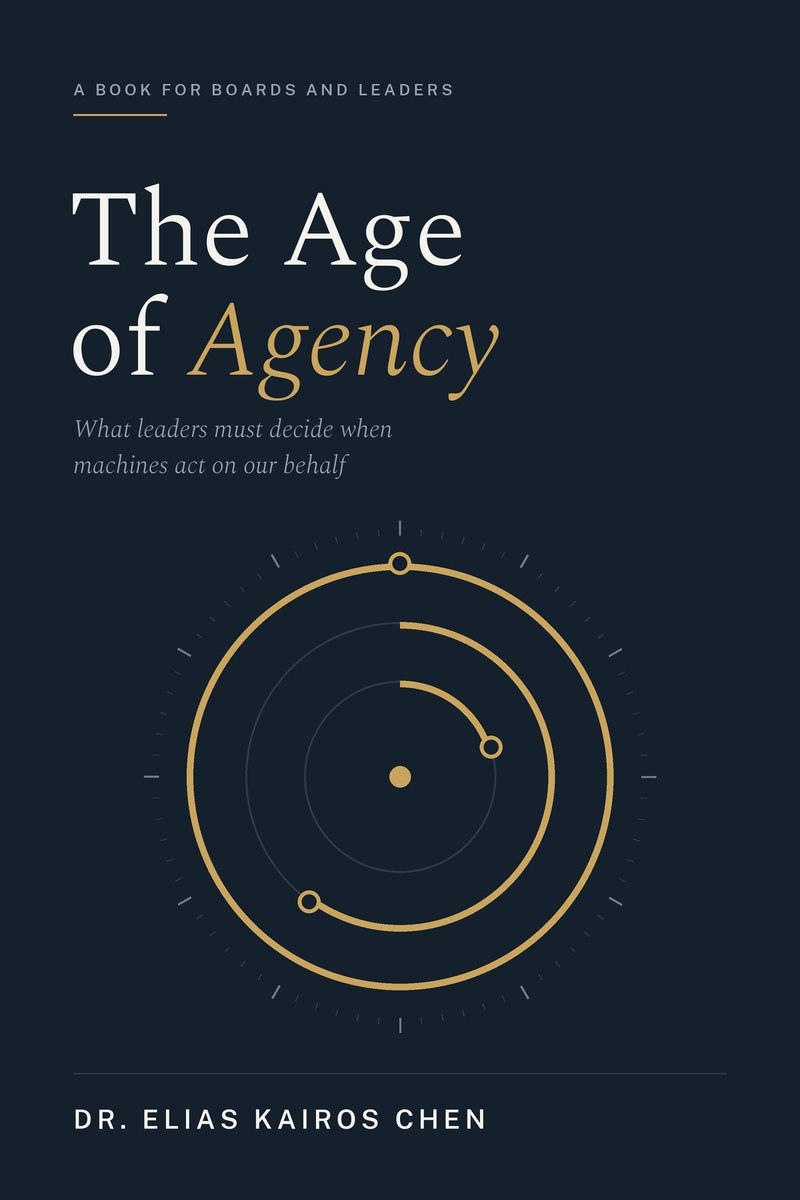
Cover of The Age of Agency by Dr. Elias Kairos Chen
ForthcomingThe Age of AgencyWhat leaders must decide when machines act on our behalf
Featured thinkingAll 54 essays →

Recent essays

Research foundations

The science underneath the strategy

My doctoral and published research is in brain-inspired artificial intelligence. Here is what that means, in plain terms.

  1. Brain-inspired AI
  2. Neuromorphic intelligence
  3. Agentic systems
  4. Enterprise and societal implications
A relationship between ideas, not a claim that these technologies are the same or must develop in this order.

Brain-inspired AI

Most AI today is loosely modelled on the brain. Brain-inspired AI goes further, borrowing how real neurons communicate, learn and adapt over time.

Why it matters for leaders: it points to AI that learns continuously from less data and uses far less energy.

Spiking neural networks

Instead of passing numbers continuously, spiking networks communicate through brief electrical pulses, as biological neurons do. Timing carries information.

Why it matters: they are well suited to signals that change over time, such as sensors, speech, physiological data and markets.

Neuromorphic computing

Hardware and software designed around the brain's architecture, processing information where it is stored rather than shuttling it back and forth.

Why it matters: it could make capable AI run on devices at the edge, with a fraction of today's energy cost.

Intelligent systems

How many specialised AI components, agents and people combine into systems that perceive, decide and act, and where those systems fail.

Why it matters: enterprise AI is becoming a system of agents, so governing the system matters as much as any single model.

Research and publications →

Intelligence, agency and enterprise value
AI progress should be judged not only by what systems can do, but by the outcomes they produce and how responsibly they are governed.
01

Organisational AI readiness

Whether an organisation can capture value from AI: strategy, data, processes, people, governance and financial measurement working together.

02

Intelligent agency and decision delegation

As AI moves from answering to acting, which decisions a machine may make, recommend, or never touch, and who remains accountable.

03

Economic value creation

Judging AI by what it does to revenue, operating costs, capital and risk, at its full cost, rather than by how widely it is adopted.

04

Responsible governance and accountability

Oversight, testing, monitoring and the ability to intervene, so that delegated decisions remain answerable to people.

From research to enterprise application

From ideas to measured outcomes

These ideas inform three applied frameworks developed through Kiros Intelligence Group. The full assessments and calculators live on kiros-intelligence.com.

  1. 1

    Research and ideas

    Brain-inspired AI, agency and the future of intelligence.

     
  2. 2

    Organisational readiness

    Can the organisation capture value from AI?

    AI Readiness & Value Index ↗
  3. 3

    Financial value creation

    Which lines in the accounts can AI move, at what full cost?

    Agent Value Ledger ↗
  4. 4

    Responsible delegation

    Which decisions may AI make, recommend, or never touch?

    AI Delegation Map ↗
  5. 5

    Measured outcomes

    Results tracked against the baseline, and reported honestly.